
Traditionally, as students, we’ve been taught to squeeze as much information on an unfamiliar topic as possible into a traditional essay, often sounding more unfamiliar with the topic than we truly are. Though there is nothing wrong with essay writing, it’s not true to how most people, excluding scholars, really speak or think. Most of us are better at expressing ourselves in ways that conform with everyday thoughts or actions
Teachers today have discovered that students benefit from practicing authentic writing, or writing that will benefit them outside the classroom. This comes in many forms, often seen in blogs such as this one, social media posts, and everyday emails. Personally, I welcome these changes. I a writing class that I am currently taking, I am learning about the news ways English teachers view writing and I’m excited about it. Heather Clayton of “Making the Standards Come Alive!” says that, Authenticity connects writers to the outside world, inspires writing for a real audience, and ensures that students’ voices are heard”, rather than the students connecting with their teacher or professor is an expert in the assigned topic. As Ken Lindblom and Leila Christenbury state in their book, Continuing the Journey, “English is not just for English class: writing is relevant, especially as a social activity” and it is important for us as educators to not only teach our students to write properly, but to have fun while doing it.
Ken and Leila recommend following a “Writing Processes Model: Power-P”. As they state, “real-world writing takes creativity, organization, strategic planning, discipline, confidence, enthusiasm, skill with language, and a thick skin”.
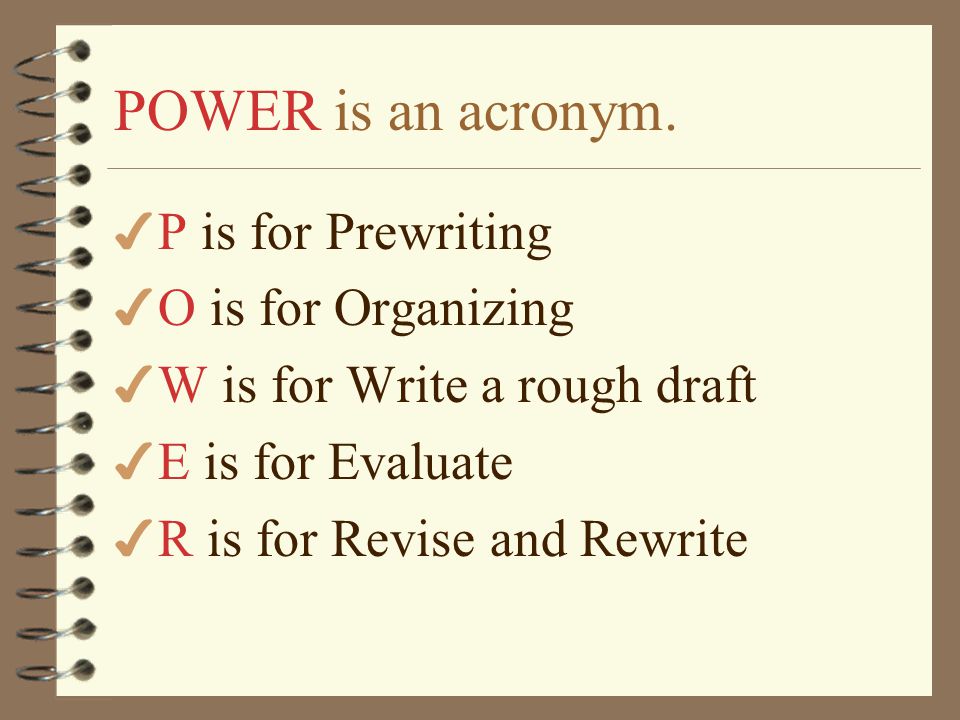
And of course, we would add a P for “Publish”!
In the first stage, writers will develop their ideas, whether through an outline or freewriting. There are no specific rules; do what works for you. Personally, I find freewriting to be less structured and more effective for me. In this pre-writing stage, writers are free to conduct research as they write through which ever sources they choose, including online line resources like blogs, social media, and online newspapers.
In the organizing stage, the writer now decides how he or she will structure the piece they are writing. Which form will it be in? Will they include all of their research or take bits and pieces out? Again, finding the specific form and flow of the piece being written is up to the writer.
Once the actual writing begins, the writer will formulate a first draft, again, picking and choosing what stays and what goes.
Once the first draft is complete, the writer will evaluate their piece and decide if it is worthy of publishing. Running this draft by peers is highly recommended.
Now that the writer has had feedback from peers, it is up to he or she to revise their piece and gear it to become a final product.
Now, with a completed paper, blog post, etc., is it time for the work to be published!
This is an exciting time for teachers, students and writers. Many of our traditional rules are no longer required with less informal pieces, but we still must incorporate proper and traditional methods into our classrooms to better prepare our students for their future.
 Nicole's Thoughts
I like how you opened this blog post with the description of “squeezing” information into an essay – and how that information is often “unfamiliar” to students. This is an important point, and especially relevant to those of us who are planning to become English teachers because it emphasizes the distance at which students often regard essays. How can they be expected to write engagingly with information that they don’t connect with? That’s why I, too, welcome the authentic writing assignment. I also like how you broke down a writing process because it makes clear the possible steps a writer could take and what to do within each one. I think it would have been cool if you had given an example of an assignment and shown how each step could be used in relation to that assignment. Also, I wonder what “proper and traditional methods” you think should still be incorporated?
LikeLike
I thought this comment got posted but I guess not… Luckily I saved it!:
I like how you opened this blog post with the description of “squeezing” information into an essay – and how that information is often “unfamiliar” to students. This is an important point, and especially relevant to those of us who are planning to become English teachers because it emphasizes the distance at which students often regard essays. How can they be expected to write engagingly with information that they don’t connect with? That’s why I, too, welcome the authentic writing assignment. I also like how you broke down a writing process because it makes clear the possible steps a writer could take and what to do within each one. I think it would have been cool if you had given an example of an assignment and shown how each step could be used in relation to that assignment. Also, I wonder what “proper and traditional methods” you think should still be incorporated?
LikeLike
Hey Nicole! I like how you compared more “traditional” writing (using the example of essays) to authentic writing. Your description of the way students are instructed to write essays is spot on; I sometimes fear when I’m writing an essay on an unfamiliar topic that the reader will be able to recognize my lack of knowledge. Unfortunately, sometimes that is the case. Just as you mentioned, essays we write for school aren’t normally structured in a way that people talk, making them somewhat awkward. Sometimes, I will explain to someone what I want to write a given essay on and it comes out in a more articulate way than the words I type out. This can be frustrating when the structure of the essay limits how I am able to convey my meaning. I also agree with you that it is an exciting time for teachers, students and writers. There are so many new methods of writing and methods that writing can be incorporated into the classroom in unique ways. I think this is also important because it gives students and teachers options to try out as opposed to the traditional type of writing instruction.
LikeLike
Hey Nicole. I thoroughly enjoyed reading your blog and think you brought up some really good points! I especially liked when you mentioned how aside from scholars, not everyone thinks in terms of essay writing. I think you brought up this idea in a way that does not shame non-scholars by any means. You simply recognized that there are other ways to read and write and communicate and one way isn’t better than the next. I find that I’m actually better at formally expressing my ideas versus speaking them or writing in an informal way; maybe it’s the way I’ve been taught, or maybe it’s just how I prefer to communicate. Regardless, I think it’s totally illogical to only teach one way (for virtually all subjects). So for this reason, I really liked how you touched on this in your blog post. Additionally, I love how you incorporated the POWERP image! I highlighted this in my book when I was completing the assigned reading. I remember this acronym so vividly from when I was in 7th grade. My English teacher gave us writing workbooks and this was the theme, in a sense, of the book. Really cool to see that you found that insightful as well because it definitely left a mark on me all these years later!!
LikeLike