
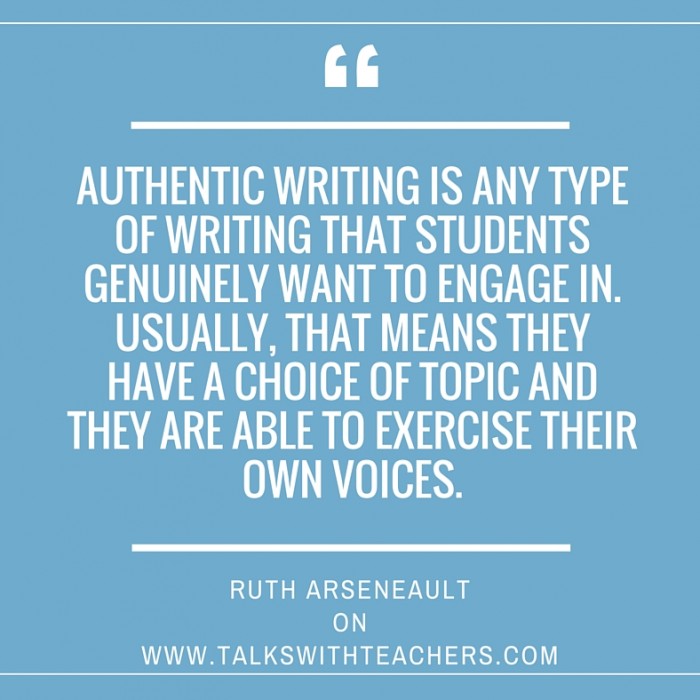
Though something we all use every day, authentic writing is a relatively new concept in the classroom. After years of telling our students what they should be writing, we are finally allowing them to tell us what they want to write and how they want to write it whether it be through a blog such as this one, a comic book story, or a letter to a particular person, bringing the joy of writing to those who would otherwise not want to write. When you think about it, very rarely after we leave school do we compose a five paragraph essay, but we will always continue to write, in one form or another, to a particular audience. This is exactly what authentic writing is and why it is so important that this form of writing that should be taught.
With the assistance of an article that I came across called “Keeping it Real: Valuing Authenticity in the Writing Classroom” by Anne Elrod Whitney as well as Ken Lindblom and Leila Christenbury’s book Continuing the Journey 2, I have stumbled upon four important factors to keep in mind when teaching authentic writing.
REMIND STUDENTS WHY AUTHENTIC WRITING IS SO IMPORTANT
We all know that authentic writing is fun, but without a purpose, the excitement will soon fizzle out. As Whitney wrote in her article, “most of of know what writing feels like when it is really authentic-when it is useful, important, or necessary to get a job done. Do our students know this? Or do they just write because it’s an assignment, the same way they do practice word problems on a worksheet?” Showing students that their writing has a purpose and can be used as a powerful tool to incite change, big or small, can be a useful motivator to get even the least motivated student to start writing.
DON’T FORGET WHAT AUTHENTIC WRITING REALLY IS
Yes, we are teachers, but when teaching authentic writing, we are not here to command what the student writes. We have to remember to take a step back and allow the student to find their own way of expressing themselves even if it is not in a way we would personally choose. Whitney suggests that we follow what I have decided to call, the 4 A’S:
- Authentic Genre– Rather than writing the usual 5 paragraph essay, summary, or book report, have students write travel essays, book reviews, and advice columns. Whitney says that genres aren’t fixed forms existing in the abstract; they are patterns of human response to recurring types of situations. Show your students that their writing can and will affect real life situations for both themselves and the audience they intend to write for.
- Authentic Process- Though students may find authentic writing to be easier than a traditional five paragraph essay, getting to their point could still be a struggle. Writing is a process, no matter which way you choose to do it. Ideas grow, change, and often develop into new ideas so it is important to keep your students grounded and focused on the task so that they don’t find themselves going off topic. Whitney suggests modeling your own writing and struggles to your students and show them the steps you take to reach your own writing goals.
- Authentic Audience- Having an audience (besides a teacher who knows more on the topic than the student) is important for a young writer because it can build both excitement and confidence for the writer, but can also help the writer direct their thoughts about their chosen topic appropriately. Whitney says that it is important for writers to gain experience with different audiences for their writing: audiences with expectations, interpretations, interests, and questions; audiences who sometimes even reply to what has been written; often seen in a blog. Whitney mentions several times throughout her article that students should write their piece more than once and direct their work towards more than one audience to allow the student to see how the information within the piece changes from one audience to another.
- Authentic Teachers and Students- I will use Whitney’s words here completely as she states it better than I ever could:
“In a writing classroom, authenticity of teachers and students means showing students what our real, unfinished, in-process writing looks like, and it means engaging in real tasks and writing those for real readers. But it also means being real people while you do it. It means letting students know you…you’re asking students to take risks. You can also risk them knowing you. So that means letting them know things about you, sure, but more importantly it means letting them know what you are like when you write. Excited. Nervous. Scared. Self-critical. Daydreamy. And when you encounter a student struggle, you respond with a “me too”.
AUTHENTIC WRITING, THOUGH GIVING STUDENTS THE FREEDOM TO WRITE AS THEY CHOOSE, STILL MUST ENSURE THAT THE STUDENTS ARE FOLLOWING THE STANDARDS OF THE CURRICULUM
A good way to assign an authentic writing assignment is to align the assignment with the text or topic that you are covering at the moment. Ken Lindblom gives an example from his book that suggests that the students participate in a fun Shakespeare authentic assignment-triangulation. In this activity, students are “asked to write a letter to Juliet’s parents from the Friar and another letter from Juliet’s nurse, both of whom aim to convince Juliet’s parents to allow her to marry Romeo. The Friar and the Nurse would have different evidence to the marshal, different tones of voice and registers to command, and different characters to exploit”. By doing this, students will be able to look at the differences between the letters for the same purpose to the same audience by two different people.
Remember that while this is fun and purposeful, authentic writing could easily lead astray and it is important as the teacher to ensure that the writing doesn’t take the wrong turn becoming offensive or punishing for anyone involved.
AUTHENTIC WRITING SHOULD COME FROM THE STUDENT’S HEARTS
Authentic writing should be meaningful to the students, even if you the teacher cannot relate to it personally. Remember, it is important to guide, but not command. Let the students write. Don’t come up with fake tasks for them to compose, but follow Whitney’s advice that authenticity means having writers work on real, meaningful tasks; not fake ones.
All in all, this is an exciting time for teachers and their students. While there are many recommendations, articles, and journals about authentic writing, I believe that the 4 helpful tips I mentioned should be helpful in the classroom.
Happy writing!

 Nicole's Thoughts