Be yourself; Everyone else is already taken.
— Oscar Wilde.
This is the first post on my new blog. I’m just getting this new blog going, so stay tuned for more. Subscribe below to get notified when I post new updates.
Be yourself; Everyone else is already taken.
— Oscar Wilde.
This is the first post on my new blog. I’m just getting this new blog going, so stay tuned for more. Subscribe below to get notified when I post new updates.
When I entered the first year of my teacher preparation, I thought I had my teaching philosophy all figured out. I had based my idea of teaching on that of my high school English teacher whom I loved and adored. I wanted to be the next Ms. D just like a little league baseball player might want to be the next Mike Piazza or David Wright. She was spunky and fun and made even the least interested student interested in what we were covering on any particular day. But as I entered my own training, I discovered that there is so much more to teaching than just having your students enjoy your class.
Albert Einstein said, “I never teach my pupils. I only attempt to provide the conditions in which they learn”. A successful teacher always tries to engage his or her students. Those that stand at the top of the class and merely speak through the lecture are speaking to blank canvases more or less. We want our students to have spent their time with us packed with knowledge, interest, motivation, and creativity- a busy canvas if you will. And the only way to do that is to provide the best learning environment possible and teaching beyond the test for what is truly important.
A large part of teaching English involves teaching writing. Though many students don’t realize it at the time, this is a skill that is used from their time in school until the end of their lives. How many other teachers have the opportunity to teach a skill like that? I don’t know about you, but I don’t plan on using the Pythagorean theorem when I’m well into my 90’s (no offense to the math teachers out there- we love you!) but I do intend to write, whether it be through a letter or starting that novel I’ve been planning to write, so we must make sure that when we teach writing, we do it correctly. Writing is essential to every single student’s future and I plan to ensure that I do everything in my power to empower and teach them along the way.
What is writing?
According to the NCTE, “writing refers to the act of creating composed knowledge”. This covers all aspects of writing, whether it be in the traditional format, a lab report, or in recent times, a text or Twitter post. When a student writes something other than a standard essay that will only be shown to the teacher who assigned the assignment, he or she is most often writing to an intended audience, whether that be themselves, their teacher, or someone in particular such as a congressman. The student must be able to adjust their tone and or vocabulary to suit each audience. When we do this, we are practicing authentic writing, the most common form of writing. If you are new to this term, authentic writing is defined as, “real writing, written for a real audience, for a real purpose, in a real forum”. I believe authentic writing is the most important type of writing because it is something the students will use for the rest of their lives. It is also a powerful tool that can change the world.
MY TEACHING PHILOSOPHY
When I finally enter the world of teaching, I want to ensure that I am providing my students with all of the necessary tools to be a writer. Not everyone thinks they can be a writer, but they can, and I have a few ideas as to how I will prove this to them.
I want my students to experiment with different genres of writing, find their comfort zone, write freely, and in turn, improve their writing skills.
All too often, students are assigned dreary writing assignments that do nothing to improve their writing. Writing should be fun and not a chore. Amy Worob, a blogger that I follow on Writers Who Care, shares my opinion. She states, “Writers write. And writers become better writers by writing (and reading). So often students are asked to write about something without actually trying the writing themselves. They write a lot of response paragraphs and essays, but how often do they write something that is of their own creation?” I believe it is important to give students the freedom to choose a genre that suits them. Whether it be fiction, a graphic novel, screen play, or a twitter feed, I want to allow them to choose a genre they are comfortable with because no matter what, they are practicing their writing and expressing their views and creativity. And of course, I’ll be there to show them various writing techniques throughout their search for the genre that suits them. Who knows, maybe I’ll have the next Stan Lee in my class!
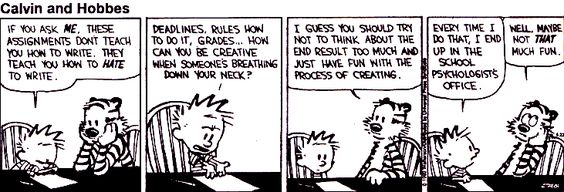
I will show my students that writing is a process, even for veteran writers.
We are all humans and we all mistakes. Shakespeare didn’t roll of bed into his 9th grade class and write Hamlet, I can assure you. Perfecting the art and skill of writing takes practice, time, mistakes, and sometimes tears (not talking anyone in particular here- ok it’s me!). Ken Lindblom and Leila Christenbury explain the writing process as “messy, halting, and recursive”. Because of this, the process can seem quite daunting for the inexperienced writer. Rather than overwhelming my students, I will use Ken and Leila’s POWER-P model and lay out the necessary steps to gather their thoughts and put pen to paper. I don’t intend on making this a robotic, rigorous process for my students, but something they will learn to appreciate and eventually do naturally.
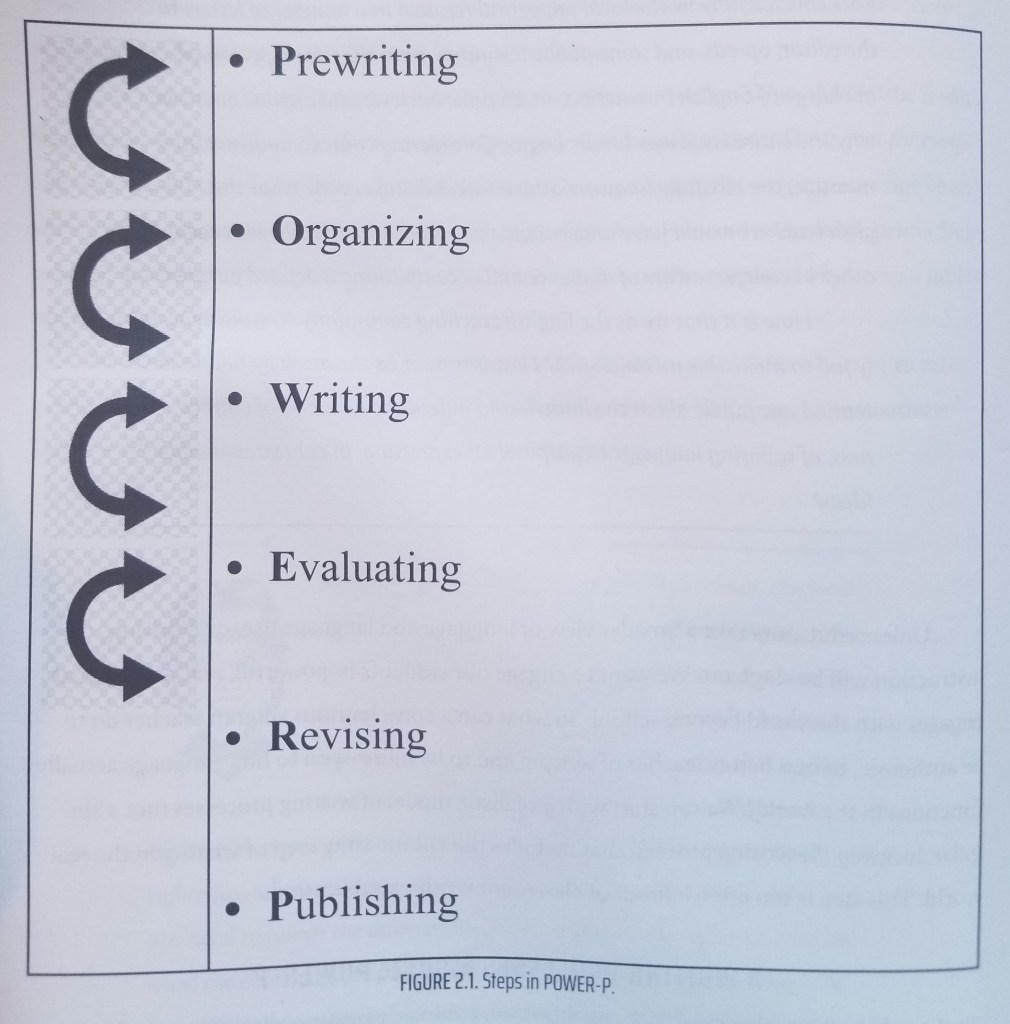
In the PREWRITING stage, writers gather their ideas and research and develop it into their main idea for whatever it is that they’re writing. Assigning Writing to Learn assignments throughout the school year can help students prepare for the prewriting stages by generating ideas and learning about particular topics.
The writer will then ORGANIZE their information into the structured format, often using a mentor text as guidance.
In the WRITING stage, the student writes their first draft.
The students must then EVALUATE their writing both on their own and through peer evaluations. I cannot stress how important peer evaluations are when done correctly. When another set of eyes reads your work, often times, those eyes will find either mistakes or things that could be explained better. Let your students know that this is a step that ALL writers go through.
Once the students have evaluated their papers, it is time to REVISE. In class peer response group work is also very helpful at this stage. Once the student is content with their work, onto the next stage!
PUBLISHING!
When we get into the car for a drive, we always have a destination to go to. If we didn’t, why would we get in the car in the first place? The same can be said for writing. I want to give my students an incentive to put 100% into their writing and I can do that by having them publish their work. Ken and Leila suggest school newspapers, blogs, or being read out loud to a real audience. I want writing to be something that my students enjoy and something that they are proud of.
In conclusion
I don’t want to be known as the teacher who made class fun for 42 minutes a day, 5 days a week, 38 a weeks a year. Sure, they might remember funny Mrs. Daly from years ago, but what else will they remember? I want to have an impact on my students. They don’t need to necessarily remember me personally, but I want them to remember what I’ve taught them and to be able to use those skills to enrich their lives and possibly others. Some will take what I’ve taught them and teach others, some might incite change through their writing in their community or even the world. Whatever they choose to do, I want to know that they can do it because I’ve done my job. And if they still think I’m funny…. hey… it’s an added bonus.

Think about the feeling you have when you start a new job. You may not be an expert in the field. You might be at the very bottom of the totem pole, where your main responsibility is to bring your supervisor coffee every day. Now picture yourself as a young student in a writing class. You might be new to writing and you might lack confidence. What is the one thing that you as a new employee and that young, new writer have in common? The answer is: you both have the desire to be taken seriously while performing the job.
Often, students are assigned assignments that are out of their comfort zone, beyond their ability, and positively boring which result in one thing or another:
“I don’t want to do this.”
“I can’t do this.”
“I’m not doing this.”
As educators, do we push on and assign the assignments anyway? Well, we could, but what good would that do? They would unwillingly do the assignment, receive a poor grade, and tell themselves that they stink at writing, which is hardly ever the case. Our students would then learn to despise writing and do anything they can to avoid it (which is virtually impossible by the way). We are English teachers- we read, we write, and appreciate the writing of so many others, so why not invite our own students to enjoy what we love so much?
OK! It sounds like a great idea!!! So I ask myself, “But how”? And I respond, “Self, I’m so glad you asked!!”.
What do your students consider good writing? For student A, The Great Gatsby might be considered a true work of writing. For Student B, it could be stories from a local newspaper. For student, C, it might be a post on Twitter. Regardless, though all quite different from each other, each of these forms of writing that I have mentioned are still considered writing and most often, good writing.
Not everyone is an F. Scott Fitzgerald nor are they all the next David Barstow of the New York Times. To appease the multitude of differences in the class, my suggestion is to assign authentic writing assignments that will not only interest most students, but strengthen their writing skills at the same time. Approach these assignments like you would with any more formal type of writing assignment. Some suggestions are:
To help your students get their ducks in a row, give them a process to follow such as the POWER-P process mentioned in Ken and Leila’s book.
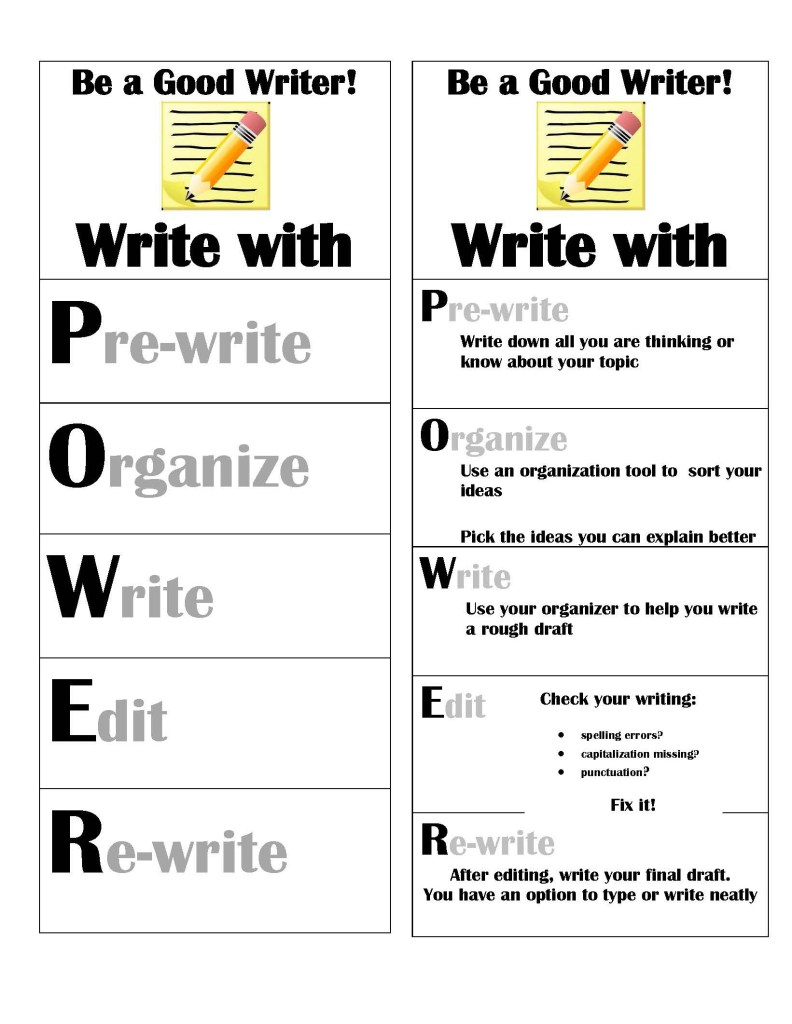
This is an easy-to-follow guide for your students. It breaks up the process into steps and minimizes what could be an overwhelming experience for the less confident writers in your classroom. Hang it up on your whiteboard and allow your students to reference it when beginning their writing process.
2. Allow your students to find a type of authentic or non-authentic writing that they just love to practice. For me, I love writing blogs, so if I had the choice to do so in the classroom, I’d be thrilled. Assign a topic and let them choose the way in which they are to express it. Their confidence will grow and they will strengthen their writing at the same time. Be sure to guide them to use various writing techniques along the way.
3. Hold a writer’s workshop that includes a one-on-one session with you and the student writer as well as small group discussion, independent writing and a peer review. Go over their writing and suggest ways to improve it. Never tell them they are headed in the wrong direction because our goal is to have them grow as a writer, not steer away from it. In real life, publishers might not be so forgiving, but we must remember that our students are not yet expert in the field and it would be unrealistic for us to expect them to write as if they were.
4. Have students use a chart such as a K-W-L chart to check their own writing!
The National Center for Educational Evaluation and Regional Assistance recommends using this chart. They say, “The cognitive writing strategy K-W-L helps students identify the gaps in their prior knowledge and guides them through what they are reading and writing. When using a K-W-L strategy to plan a research paper, students can complete the first two columns while doing their research and the last column after completing their research.
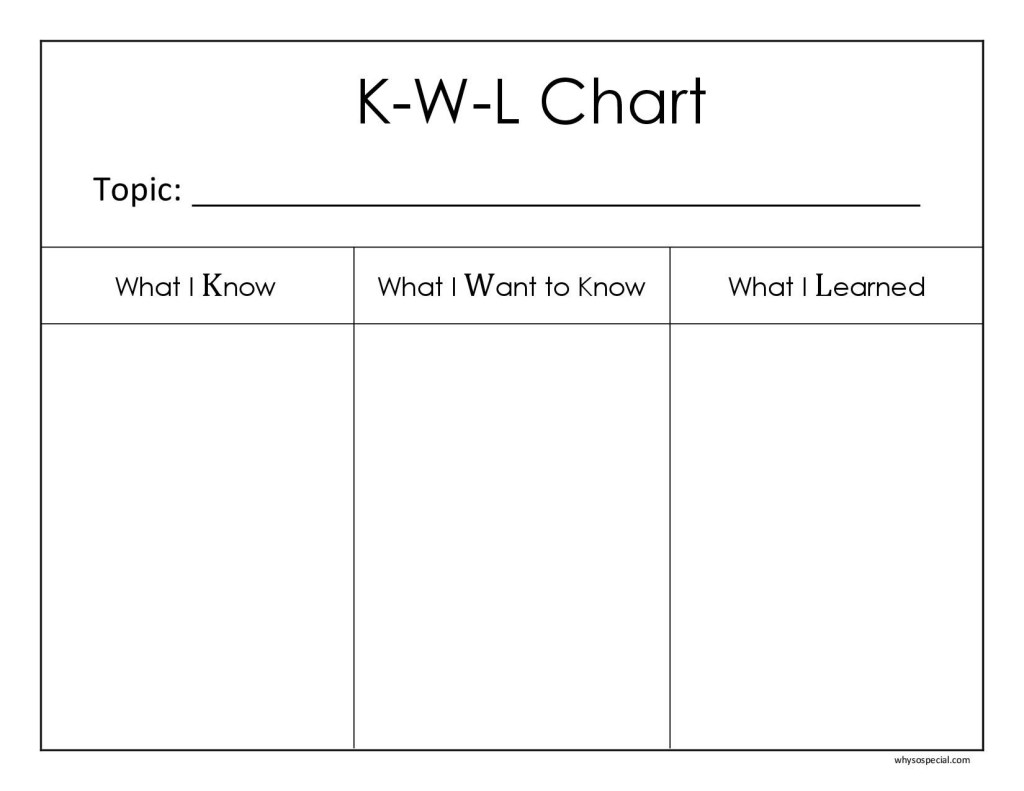
Using a strategy such as K-W-L fosters students’ strategic thinking by enabling them to approach
a research paper (or any paper) in a purposeful way. They can summarize their prior knowledge (K column), develop research questions (W column), and track new information they gather (L column)”. (8)
5. Take your students seriously. Their struggles and fears are able to be overcome with the right guidance and it is your job to offer that guidance. Just as the new employee running down the hall with her boss’ coffee is secretly begging for approval, your student is too.
Remember, you were in their shoes once….
I’ve recently had the opportunity to read Jim Burke’s The 6 Academic Writing Assignments: Designing the User’s Journey. This book is jam-packed with useful information and as a future English teacher, I cannot wait to incorporate some if not all of his ideas into my classroom.
In his book, Burke offers information and support on the following writing assignments that most English teachers use:
All of these topics are equally important, but because there is just so much information in Burke’s book, for this blog, I am focusing on three important things that I took away from the first 3 chapters that I will be using in my own classroom. Let’s begin…
WRITING TO LEARN (WTL)
Mr. Burke says that “writing to learn (WTL) is an informal type of writing often done in a notebook, while taking notes, or following the conventions of a specific discipline (e.g., scientific lab notes)” (3-4)…WTL asks students to think, to use writing as a tool to help them understand, explore, and discover as they read, write, or discuss different texts and topics” (11). So, when he says informal, Mr. Burke makes it clear that this form of writing is merely a way for his students to acquire the knowledge needed for the assignment, practice their writing, and not worry about being tested on it. The idea is to have students generate ideas and learn.
To keep his students writing and ensuring that they are taking their WTL assignments seriously, Mr. Burke recommends having students use daybooks which he collects at the end of the three grading periods. The first grade of their daybook is replaced with their second grade. Finally, the third grade counts as their final grade. He says that the “aim of this approach is to reward their improvement in the area of WTL assignments and give them cause to keep working in this area, instead of laboring under the weight of three massive grades they otherwise get” (13). Students can do their daybook work on Google Docs or a daybook app. As long as they’re writing, that’s all that really matters.Again, the idea is to generate ideas and learn, and in the end, to enjoy their writing as it should be an enjoyable experience and not a chore.
For years, teachers have been devising ways to increase the use and benefit of WTL assignments. I think Burke’s approach is the least overwhelming and most rewarding for both the teacher and the student.
FORMS AND FEATURES OF WTL ASSIGNMENTS
Besides daybooks, there are other forms of WTL assignments and activities that Mr. Burke points out. One of my favorites is “SAYS-MEANS-MATTERS”. I don’t have copyright permission to upload the actual chart from his book, but here is the jist of it:
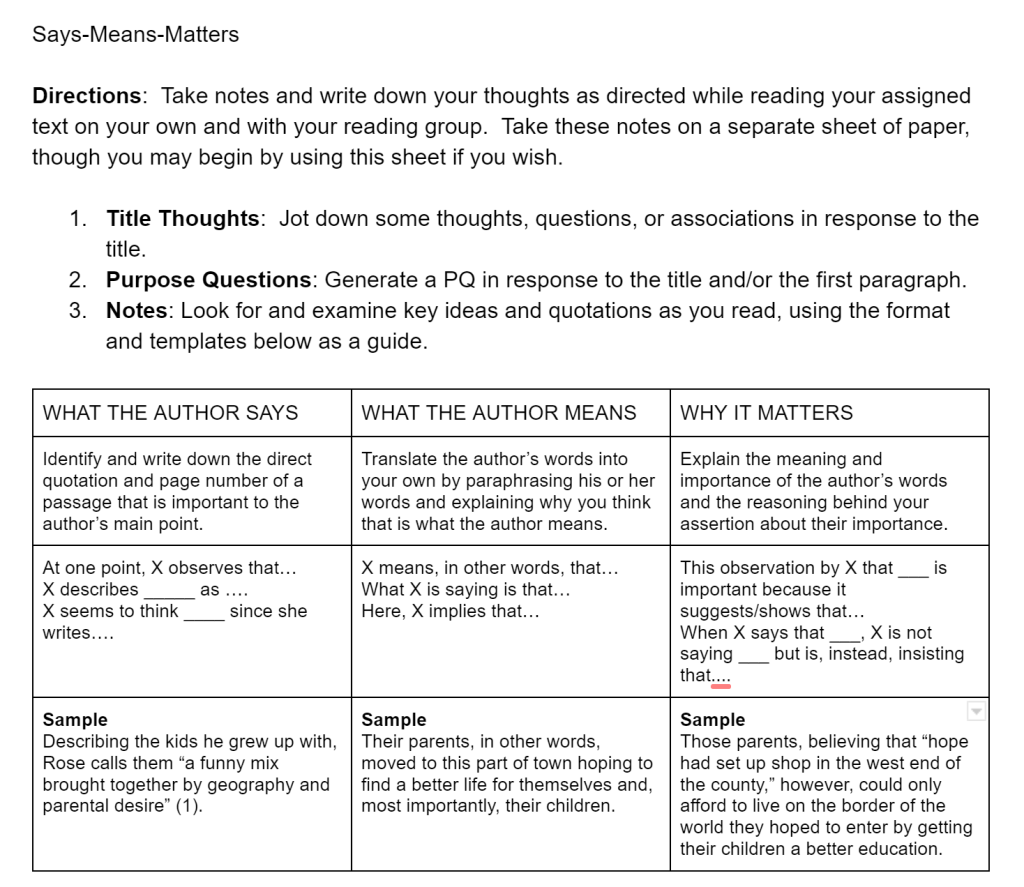
This activity puts what the student has read into a chart that breaks up their ideas and is easy to formulate and analyze. It is helpful for any student, but especially those who may have had trouble understanding the text because it breaks down the idea of the text and the author’s intentions in an easy 3 piece chart.
Other WTL activities include jotting down ideas on post-its or white boards, daybook journal writing, Topic Target organizers, and They Say/I Say charts.
Writing on Demand (WOD)
No one likes to be told what to write, when to write, and how long they can write for. WOD assignment can bring anxiety on for a lot of students, so it is important to be versatile when you assign it. Burke tells us 4 ways he incorporates WOD into his classroom and how it works for his students. Here are the two I really liked:
The Summer Reading and Independent Reading assignments give the students a sense of freedom when preparing for their papers. By also allowing the students to refer to their WTL activity sheets and notes, the students are more likely to be less stressed when doing their WOD assignments.
To all educators and future educators, if there is one piece of summer reading I would recommend to you, it would be Jim Burke’s book. Use it the way he wants our students to use it. Practice what you preach! Take WTL notes, make charts, use post its, and write about it. This is all useful information we should all bring to our classrooms to benefit not only our own teaching career, but the academic success of our students.


Though something we all use every day, authentic writing is a relatively new concept in the classroom. After years of telling our students what they should be writing, we are finally allowing them to tell us what they want to write and how they want to write it whether it be through a blog such as this one, a comic book story, or a letter to a particular person, bringing the joy of writing to those who would otherwise not want to write. When you think about it, very rarely after we leave school do we compose a five paragraph essay, but we will always continue to write, in one form or another, to a particular audience. This is exactly what authentic writing is and why it is so important that this form of writing that should be taught.
With the assistance of an article that I came across called “Keeping it Real: Valuing Authenticity in the Writing Classroom” by Anne Elrod Whitney as well as Ken Lindblom and Leila Christenbury’s book Continuing the Journey 2, I have stumbled upon four important factors to keep in mind when teaching authentic writing.
REMIND STUDENTS WHY AUTHENTIC WRITING IS SO IMPORTANT
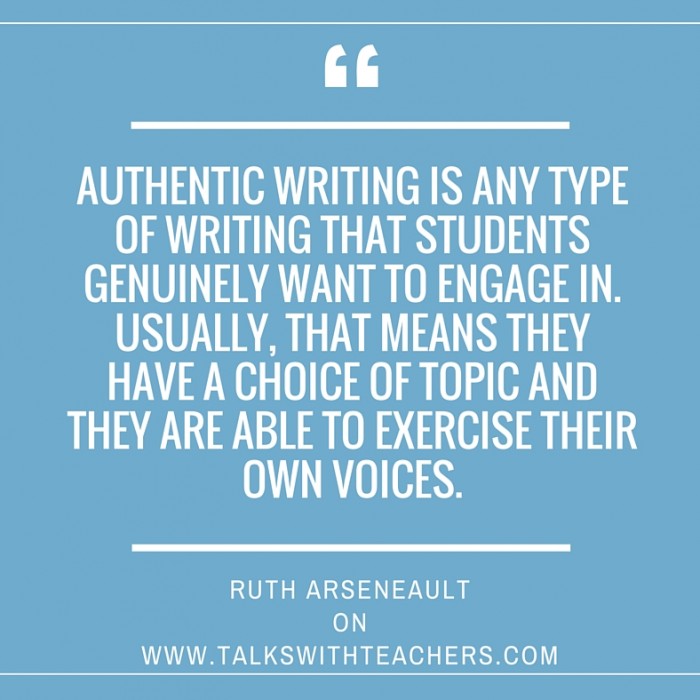
We all know that authentic writing is fun, but without a purpose, the excitement will soon fizzle out. As Whitney wrote in her article, “most of of know what writing feels like when it is really authentic-when it is useful, important, or necessary to get a job done. Do our students know this? Or do they just write because it’s an assignment, the same way they do practice word problems on a worksheet?” Showing students that their writing has a purpose and can be used as a powerful tool to incite change, big or small, can be a useful motivator to get even the least motivated student to start writing.
DON’T FORGET WHAT AUTHENTIC WRITING REALLY IS
Yes, we are teachers, but when teaching authentic writing, we are not here to command what the student writes. We have to remember to take a step back and allow the student to find their own way of expressing themselves even if it is not in a way we would personally choose. Whitney suggests that we follow what I have decided to call, the 4 A’S:
“In a writing classroom, authenticity of teachers and students means showing students what our real, unfinished, in-process writing looks like, and it means engaging in real tasks and writing those for real readers. But it also means being real people while you do it. It means letting students know you…you’re asking students to take risks. You can also risk them knowing you. So that means letting them know things about you, sure, but more importantly it means letting them know what you are like when you write. Excited. Nervous. Scared. Self-critical. Daydreamy. And when you encounter a student struggle, you respond with a “me too”.
AUTHENTIC WRITING, THOUGH GIVING STUDENTS THE FREEDOM TO WRITE AS THEY CHOOSE, STILL MUST ENSURE THAT THE STUDENTS ARE FOLLOWING THE STANDARDS OF THE CURRICULUM
A good way to assign an authentic writing assignment is to align the assignment with the text or topic that you are covering at the moment. Ken Lindblom gives an example from his book that suggests that the students participate in a fun Shakespeare authentic assignment-triangulation. In this activity, students are “asked to write a letter to Juliet’s parents from the Friar and another letter from Juliet’s nurse, both of whom aim to convince Juliet’s parents to allow her to marry Romeo. The Friar and the Nurse would have different evidence to the marshal, different tones of voice and registers to command, and different characters to exploit”. By doing this, students will be able to look at the differences between the letters for the same purpose to the same audience by two different people.
Remember that while this is fun and purposeful, authentic writing could easily lead astray and it is important as the teacher to ensure that the writing doesn’t take the wrong turn becoming offensive or punishing for anyone involved.
AUTHENTIC WRITING SHOULD COME FROM THE STUDENT’S HEARTS
Authentic writing should be meaningful to the students, even if you the teacher cannot relate to it personally. Remember, it is important to guide, but not command. Let the students write. Don’t come up with fake tasks for them to compose, but follow Whitney’s advice that authenticity means having writers work on real, meaningful tasks; not fake ones.
All in all, this is an exciting time for teachers and their students. While there are many recommendations, articles, and journals about authentic writing, I believe that the 4 helpful tips I mentioned should be helpful in the classroom.
Happy writing!


Traditionally, as students, we’ve been taught to squeeze as much information on an unfamiliar topic as possible into a traditional essay, often sounding more unfamiliar with the topic than we truly are. Though there is nothing wrong with essay writing, it’s not true to how most people, excluding scholars, really speak or think. Most of us are better at expressing ourselves in ways that conform with everyday thoughts or actions
Teachers today have discovered that students benefit from practicing authentic writing, or writing that will benefit them outside the classroom. This comes in many forms, often seen in blogs such as this one, social media posts, and everyday emails. Personally, I welcome these changes. I a writing class that I am currently taking, I am learning about the news ways English teachers view writing and I’m excited about it. Heather Clayton of “Making the Standards Come Alive!” says that, Authenticity connects writers to the outside world, inspires writing for a real audience, and ensures that students’ voices are heard”, rather than the students connecting with their teacher or professor is an expert in the assigned topic. As Ken Lindblom and Leila Christenbury state in their book, Continuing the Journey, “English is not just for English class: writing is relevant, especially as a social activity” and it is important for us as educators to not only teach our students to write properly, but to have fun while doing it.
Ken and Leila recommend following a “Writing Processes Model: Power-P”. As they state, “real-world writing takes creativity, organization, strategic planning, discipline, confidence, enthusiasm, skill with language, and a thick skin”.
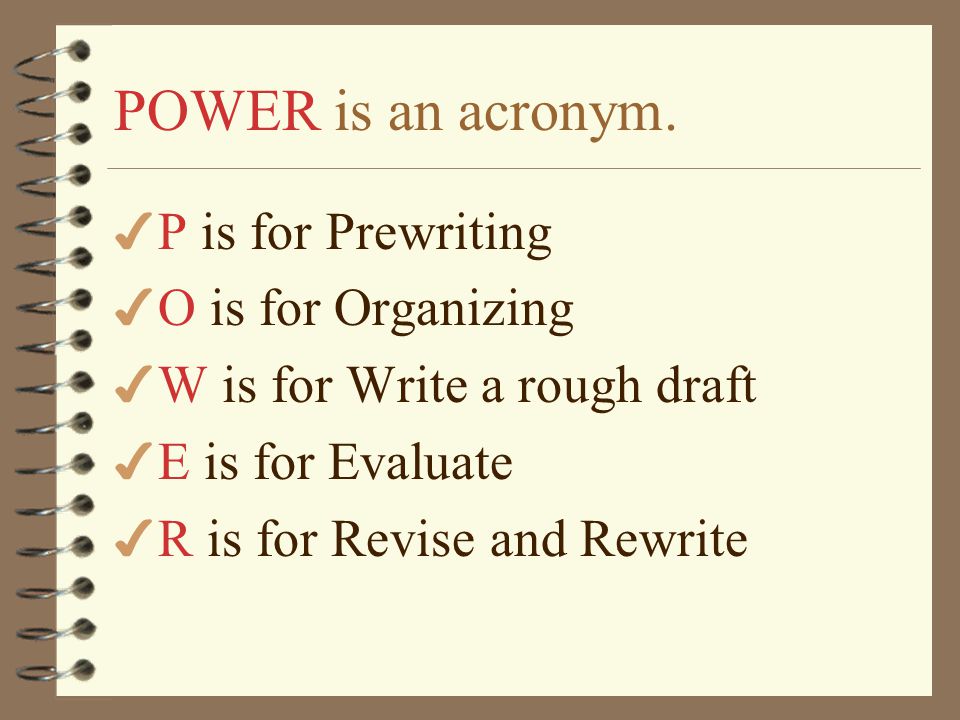
And of course, we would add a P for “Publish”!
In the first stage, writers will develop their ideas, whether through an outline or freewriting. There are no specific rules; do what works for you. Personally, I find freewriting to be less structured and more effective for me. In this pre-writing stage, writers are free to conduct research as they write through which ever sources they choose, including online line resources like blogs, social media, and online newspapers.
In the organizing stage, the writer now decides how he or she will structure the piece they are writing. Which form will it be in? Will they include all of their research or take bits and pieces out? Again, finding the specific form and flow of the piece being written is up to the writer.
Once the actual writing begins, the writer will formulate a first draft, again, picking and choosing what stays and what goes.
Once the first draft is complete, the writer will evaluate their piece and decide if it is worthy of publishing. Running this draft by peers is highly recommended.
Now that the writer has had feedback from peers, it is up to he or she to revise their piece and gear it to become a final product.
Now, with a completed paper, blog post, etc., is it time for the work to be published!
This is an exciting time for teachers, students and writers. Many of our traditional rules are no longer required with less informal pieces, but we still must incorporate proper and traditional methods into our classrooms to better prepare our students for their future.
Back when I attended community college, I had a wonderful old woman as an English professor. She was well into her 80’s but was a tough cookie and made sure she showed us all that she had no intention of retiring any time soon. She was very wise and extremely passionate not only about the literature she taught, but how students wrote about the literature. Her yearning to have students write well did not stop in her classroom though. She was wise enough to realize that proper writing, even informal writing, was an important task for anyone to learn. She told me a story about the importance of being able to write well and how it is such an important skill that is all too often overlooked for non-English majors.
In the 1960’s, the professor’s husband had left her, leaving her as a single mother with three children and no child support. Her job as a teacher wasn’t paying the bills, so she decided to look for extra work in the evenings. She advertised herself as a writing tutor on a bulletin board in a local hospital. To her surprise, the calls starting coming so fast that face-to-face tutoring was no longer an option; she would need to have a class. And who was making these calls you ask? The doctors at the hospital!
Having spent their university careers in focusing on the medical field, doctors often miss out on the opportunity to learn how to write properly and effectively. People’s lives depend on the doctor’s direction and instruction and a simple error within their writing could be misinterpreted resulting in a dire situation. Thankfully, the doctors who met with my professor took the steps to improve their writing as did many more after them. She held her evening group sessions at the hospital for many years until she no longer needed the extra income.
When we think of writing, we tend to thing of the usual suspects: novels, articles, papers, and journals. But as stated in the blog, Writing in the Work World, today’s technology results in people from all career paths writing more than ever before using other means such as email and social media to express themselves. In another blog, Everyday Writing: Words Matter More Than Ever in 21st Century Workplace, stats show that the average person spends up to four hours a day writing in some way, shape or form, whether it be through emails, text messages, or their favorite social media platform. What we would consider proper writing is now getting lost in quick responses or ten 2-line back and forth chats instead of a five page letter. As educators it is important to keep this all in mind when teaching our students to write. Yes, we want them to be able to write a scholarly article, but we also want them to be able to communicate with employees, co-workers, friends and family in an efficient manner through email or text as well.
It is important to realize that not all of your students will become English majors, but all of your students will have a job in adulthood and it is your job to prepare them as best as you can. Giving them the skills to draft all types of documents whether it be a paper on Shakespeare, a cover letter for a resume, or an email will only help them grow in the future and help them grow into successful adults.
This is an example post, originally published as part of Blogging University. Enroll in one of our ten programs, and start your blog right.
You’re going to publish a post today. Don’t worry about how your blog looks. Don’t worry if you haven’t given it a name yet, or you’re feeling overwhelmed. Just click the “New Post” button, and tell us why you’re here.
Why do this?
The post can be short or long, a personal intro to your life or a bloggy mission statement, a manifesto for the future or a simple outline of your the types of things you hope to publish.
To help you get started, here are a few questions:
You’re not locked into any of this; one of the wonderful things about blogs is how they constantly evolve as we learn, grow, and interact with one another — but it’s good to know where and why you started, and articulating your goals may just give you a few other post ideas.
Can’t think how to get started? Just write the first thing that pops into your head. Anne Lamott, author of a book on writing we love, says that you need to give yourself permission to write a “crappy first draft”. Anne makes a great point — just start writing, and worry about editing it later.
When you’re ready to publish, give your post three to five tags that describe your blog’s focus — writing, photography, fiction, parenting, food, cars, movies, sports, whatever. These tags will help others who care about your topics find you in the Reader. Make sure one of the tags is “zerotohero,” so other new bloggers can find you, too.
Have a WordPress.com account? Log in now.

