I’ve recently had the opportunity to read Jim Burke’s The 6 Academic Writing Assignments: Designing the User’s Journey. This book is jam-packed with useful information and as a future English teacher, I cannot wait to incorporate some if not all of his ideas into my classroom.
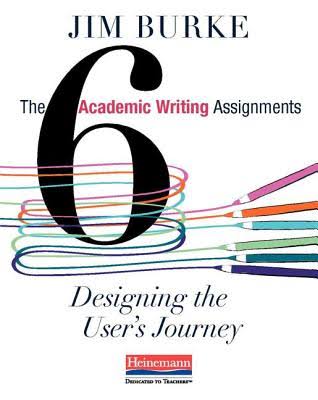
In his book, Burke offers information and support on the following writing assignments that most English teachers use:
- Writing to Learn
- Short-Answer Writing
- Writing on Demand
- Process Paper
- Research Paper or Report
- Alternative Forms
All of these topics are equally important, but because there is just so much information in Burke’s book, for this blog, I am focusing on three important things that I took away from the first 3 chapters that I will be using in my own classroom. Let’s begin…
WRITING TO LEARN (WTL)
Mr. Burke says that “writing to learn (WTL) is an informal type of writing often done in a notebook, while taking notes, or following the conventions of a specific discipline (e.g., scientific lab notes)” (3-4)…WTL asks students to think, to use writing as a tool to help them understand, explore, and discover as they read, write, or discuss different texts and topics” (11). So, when he says informal, Mr. Burke makes it clear that this form of writing is merely a way for his students to acquire the knowledge needed for the assignment, practice their writing, and not worry about being tested on it. The idea is to have students generate ideas and learn.
To keep his students writing and ensuring that they are taking their WTL assignments seriously, Mr. Burke recommends having students use daybooks which he collects at the end of the three grading periods. The first grade of their daybook is replaced with their second grade. Finally, the third grade counts as their final grade. He says that the “aim of this approach is to reward their improvement in the area of WTL assignments and give them cause to keep working in this area, instead of laboring under the weight of three massive grades they otherwise get” (13). Students can do their daybook work on Google Docs or a daybook app. As long as they’re writing, that’s all that really matters.Again, the idea is to generate ideas and learn, and in the end, to enjoy their writing as it should be an enjoyable experience and not a chore.
For years, teachers have been devising ways to increase the use and benefit of WTL assignments. I think Burke’s approach is the least overwhelming and most rewarding for both the teacher and the student.
FORMS AND FEATURES OF WTL ASSIGNMENTS
Besides daybooks, there are other forms of WTL assignments and activities that Mr. Burke points out. One of my favorites is “SAYS-MEANS-MATTERS”. I don’t have copyright permission to upload the actual chart from his book, but here is the jist of it:
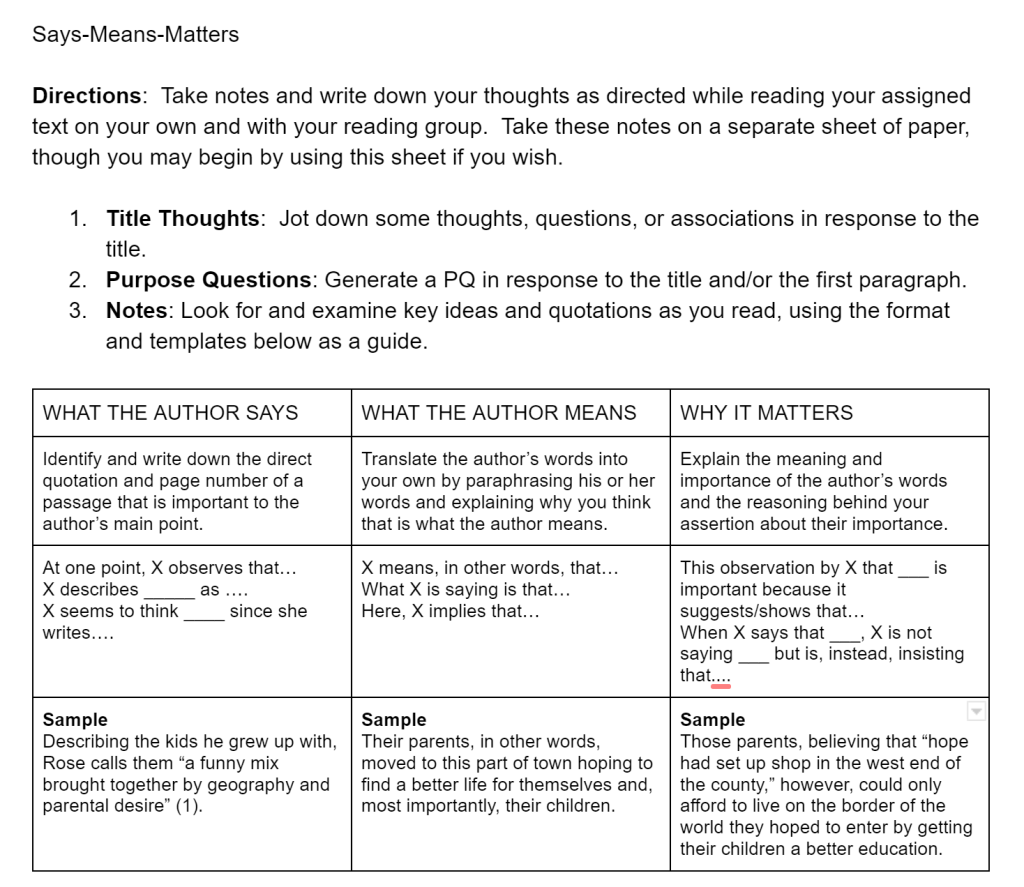
This activity puts what the student has read into a chart that breaks up their ideas and is easy to formulate and analyze. It is helpful for any student, but especially those who may have had trouble understanding the text because it breaks down the idea of the text and the author’s intentions in an easy 3 piece chart.
Other WTL activities include jotting down ideas on post-its or white boards, daybook journal writing, Topic Target organizers, and They Say/I Say charts.
Writing on Demand (WOD)
No one likes to be told what to write, when to write, and how long they can write for. WOD assignment can bring anxiety on for a lot of students, so it is important to be versatile when you assign it. Burke tells us 4 ways he incorporates WOD into his classroom and how it works for his students. Here are the two I really liked:
- Summer Reading: Students are asked to read a biography, autobiography, or memoir related to a person or a group of people worth studying. He then combines the reading with an extended profile from the New York Times. Students return to school with their notes and books and write by hand about the readings for 45 minutes. This causes less stress on the students and less of a workload for the teachers.
- Independent Reading: Students read two independent reading books each semester- two in the fall, two in the Spring. They are non-fiction and related to their major paper due at the end of the school year. The students are urged to bring their notes and WTL activity sheets (They Say/I Say). The students write their essays in class and have one hour to do so.
The Summer Reading and Independent Reading assignments give the students a sense of freedom when preparing for their papers. By also allowing the students to refer to their WTL activity sheets and notes, the students are more likely to be less stressed when doing their WOD assignments.
To all educators and future educators, if there is one piece of summer reading I would recommend to you, it would be Jim Burke’s book. Use it the way he wants our students to use it. Practice what you preach! Take WTL notes, make charts, use post its, and write about it. This is all useful information we should all bring to our classrooms to benefit not only our own teaching career, but the academic success of our students.

 Nicole's Thoughts
This blog post is so well structured and very informative. You did a great job of summarizing the book up to Chapter three and the use of bullet points to touch on major points was very effective. Day books are such a great idea and they are something I would implement in my future classroom. I would agree that this is a fabulous tool a teacher could use to motivate students to write. I loved the “SAYS-MEANS-MATTERS” thing that Burke mentions, also. This tool can be used to help students get a better idea on how to formulate a cohesive thesis statement later in their academic career. I also loved the images you included in the blog post because they were relevant and very effective at illustrating your points. Overall, what a great blog post! I look forward to reading future posts by you.
LikeLike
Thanks, Jeff!!
LikeLike