Think about the feeling you have when you start a new job. You may not be an expert in the field. You might be at the very bottom of the totem pole, where your main responsibility is to bring your supervisor coffee every day. Now picture yourself as a young student in a writing class. You might be new to writing and you might lack confidence. What is the one thing that you as a new employee and that young, new writer have in common? The answer is: you both have the desire to be taken seriously while performing the job.
Often, students are assigned assignments that are out of their comfort zone, beyond their ability, and positively boring which result in one thing or another:
“I don’t want to do this.”
“I can’t do this.”
“I’m not doing this.”
As educators, do we push on and assign the assignments anyway? Well, we could, but what good would that do? They would unwillingly do the assignment, receive a poor grade, and tell themselves that they stink at writing, which is hardly ever the case. Our students would then learn to despise writing and do anything they can to avoid it (which is virtually impossible by the way). We are English teachers- we read, we write, and appreciate the writing of so many others, so why not invite our own students to enjoy what we love so much?
OK! It sounds like a great idea!!! So I ask myself, “But how”? And I respond, “Self, I’m so glad you asked!!”.
What do your students consider good writing? For student A, The Great Gatsby might be considered a true work of writing. For Student B, it could be stories from a local newspaper. For student, C, it might be a post on Twitter. Regardless, though all quite different from each other, each of these forms of writing that I have mentioned are still considered writing and most often, good writing.
Not everyone is an F. Scott Fitzgerald nor are they all the next David Barstow of the New York Times. To appease the multitude of differences in the class, my suggestion is to assign authentic writing assignments that will not only interest most students, but strengthen their writing skills at the same time. Approach these assignments like you would with any more formal type of writing assignment. Some suggestions are:
- Show them how real writers write. As Ken Lindblom and Leila Christenbury state in their book, Continuing the Journey 2, the writing process is “a messy, halting, and recursive process, not a neat deposit made into the account of a writer from some very full and very golden writing bank in the sky” (17). Real writers make mistakes all the time and so will they. And guess what? THAT’S OK!
To help your students get their ducks in a row, give them a process to follow such as the POWER-P process mentioned in Ken and Leila’s book.
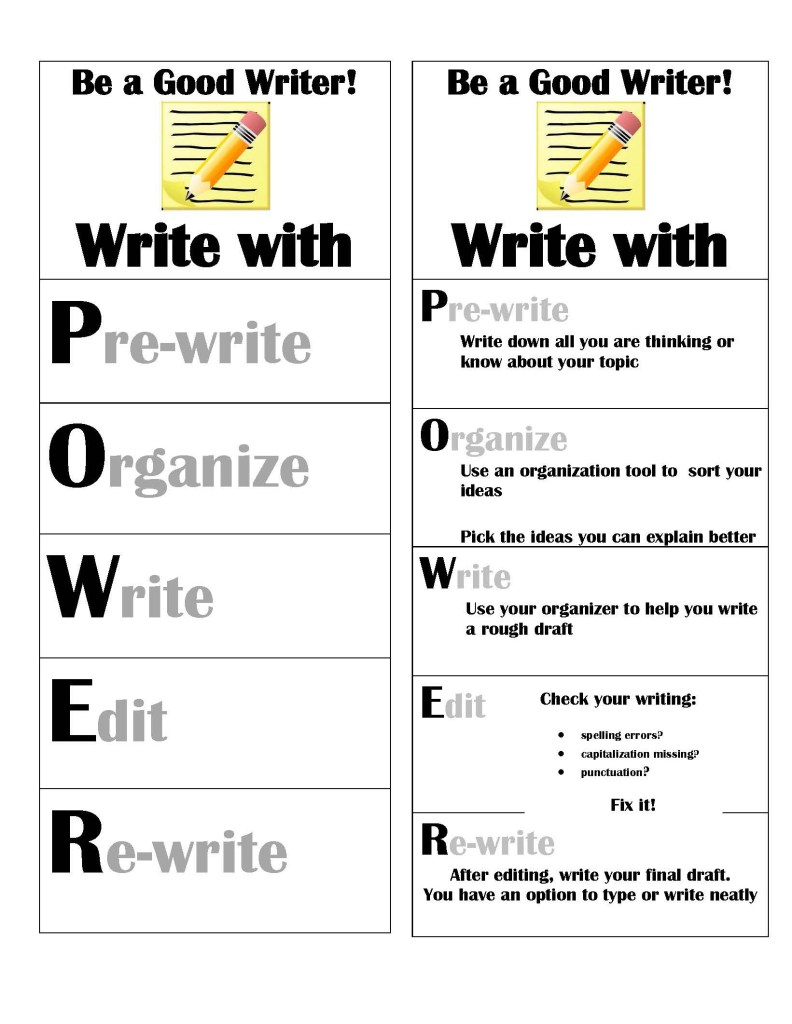
This is an easy-to-follow guide for your students. It breaks up the process into steps and minimizes what could be an overwhelming experience for the less confident writers in your classroom. Hang it up on your whiteboard and allow your students to reference it when beginning their writing process.
2. Allow your students to find a type of authentic or non-authentic writing that they just love to practice. For me, I love writing blogs, so if I had the choice to do so in the classroom, I’d be thrilled. Assign a topic and let them choose the way in which they are to express it. Their confidence will grow and they will strengthen their writing at the same time. Be sure to guide them to use various writing techniques along the way.
3. Hold a writer’s workshop that includes a one-on-one session with you and the student writer as well as small group discussion, independent writing and a peer review. Go over their writing and suggest ways to improve it. Never tell them they are headed in the wrong direction because our goal is to have them grow as a writer, not steer away from it. In real life, publishers might not be so forgiving, but we must remember that our students are not yet expert in the field and it would be unrealistic for us to expect them to write as if they were.
4. Have students use a chart such as a K-W-L chart to check their own writing!
The National Center for Educational Evaluation and Regional Assistance recommends using this chart. They say, “The cognitive writing strategy K-W-L helps students identify the gaps in their prior knowledge and guides them through what they are reading and writing. When using a K-W-L strategy to plan a research paper, students can complete the first two columns while doing their research and the last column after completing their research.
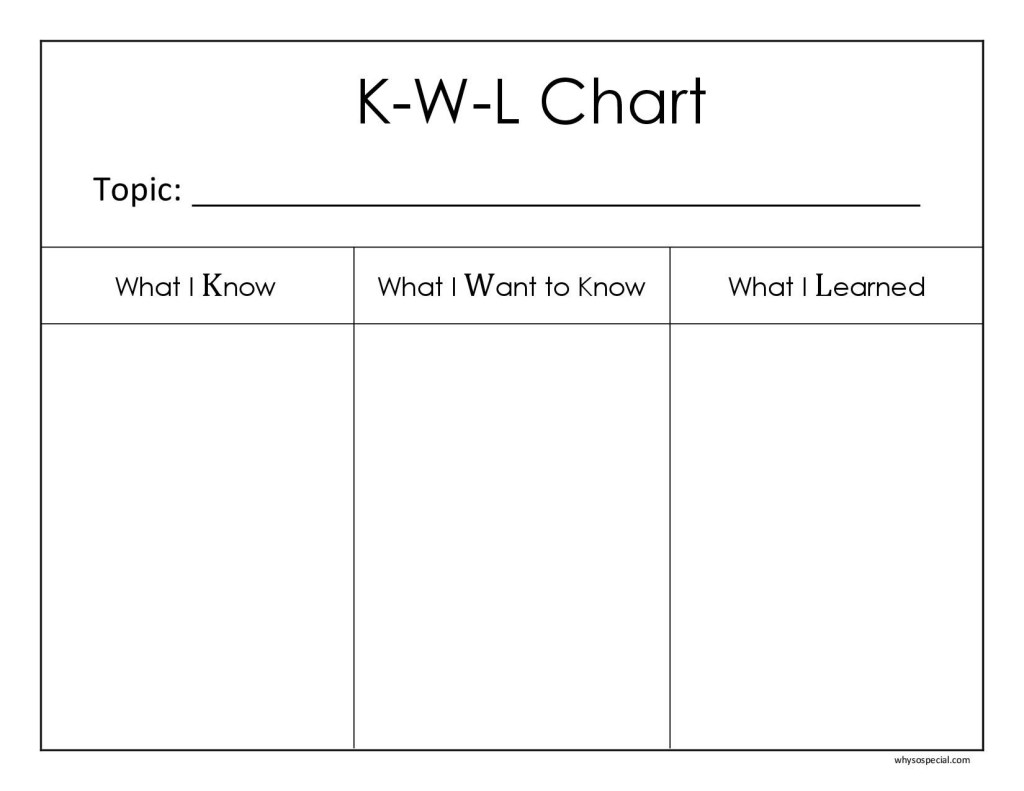
Using a strategy such as K-W-L fosters students’ strategic thinking by enabling them to approach
a research paper (or any paper) in a purposeful way. They can summarize their prior knowledge (K column), develop research questions (W column), and track new information they gather (L column)”. (8)
5. Take your students seriously. Their struggles and fears are able to be overcome with the right guidance and it is your job to offer that guidance. Just as the new employee running down the hall with her boss’ coffee is secretly begging for approval, your student is too.
Remember, you were in their shoes once….
 Nicole's Thoughts
Nicole,
I really enjoyed reading your blog post entry. I thought it was very insightful and very well written as well as easy to read. The point that resonated with me the most is the first point where you discuss giving and teaching your students a writing process and the importance of the writing process. I think however it is also important for students to know that there is not just one specific writing process that they have to follow. It is important to give students suggestions about writings process but it is more important for students to use a writing process that works for them.
LikeLiked by 1 person
Hi,
I really enjoy reading your blogs Nicole. I think you formatted this in a way that’s very conducive to easy reading. I think the points you made were well articulated and well supported. I like how you mentioned that writing looks different for every student. I like how you discussed the “showing your students what writing looks like” aspect; this reminds me of the article we read about the process logs and writing along with your students. The KWL chart is such a powerful too; I remember using that in school and I found it very helpful. So I’m happy to see it’s being mentioned in our books!
LikeLiked by 1 person
Hi Nicole. I really enjoyed reading your post. In particular, I really appreciated your second section, where you write that students should practice writing in a medium that they enjoy to write in. As you point out, writing is a necessary skill in life, but so many have their growth stunted by boring and inaccessible writing assignments. This is a problem, because after high school most people will not be in a classroom setting to practice their writing–at least not as much as us in the humanities. To return to your second section, real writers write in a medium that they enjoy to write in. A student might not find their voice in the conventional academic paper; they need the space to see what works for them.
LikeLike